On this Fourth of July, it’s instructive for Americans to consider the parallels between King George and the colonists who fought a battle for their freedom, alongside Israeli Prime Minister Netanyahu and the Palestinians fighting today in Jenin for their freedom.
Lora Lucero visiting Gaza in 2012-2013
The Revolutionary War lasted nearly 8 years, largely because King George refused to surrender the colonies. The current battle in the Occupied Palestinian Territories has been ongoing since at least the beginning of the military occupation in 1967 but has its roots in the Nakba (“catastrophe”) of 1948 when Jewish militants forcibly expelled 700,000 Palestinians from their homes and businesses, murdering many and destroying over 500 Palestinian villages. Every Israeli government since has refused to surrender the occupied territories.
Prime Minister Netanyahu says “Jenin has turned into a safe haven for terrorism. We are putting an end to this.” However, Israel’s military is not engaged in an anti-terror operation; it is an attempt to suppress an uprising. The people of Palestine, most visibly those in Jenin, are determined to be a free people on their own land.
The U.N. and international law recognize the legitimate claim of sovereignty that Palestinians have over their lands. While it might have been a disputed point when the colonists were fighting the British, today it’s not disputed under international law that the Palestinians are, in fact, on their land and Israel is an occupying force.
Liberty and justice are fundamental human rights that motivated the American colonists and which the Palestinians yearn for today. Yet many Americans don’t see or understand this connection with our own founding story.
On this, our American Independence Day, we should note that those Thirteen Colonies who set out to achieve “life, liberty and the pursuit of happiness” were not the last people to have such expectations. From the Palestinian perspective, Jenin is their Lexington and Concord. It is time for the U.S. to call upon Israel to withdraw its forces and end the decades-long military occupation. Americans must affirm our founding principles of liberty and justice for all, including for the Palestinians.
Did you know that Israeli settlers who live in the occupied territories of the West Bank have access to PayPal (the world’s largest online payment processor) but their immediate neighbors, the Palestinians, do not? PayPal has been withholding its services to Palestinians — a fact I didn’t know until today.
I learned from MPower Change @MPower_Change that PayPal shareholders will vote today on a proposal to extend services to Palestinians in the West Bank and Gaza. In his 2022 Annual Report, the PayPal CEO reported “Today, we are empowering hundreds of millions of consumers and merchants to join and thrive in the global economy, and we’re contributing every day to expanding economic opportunity for customers and communities around the world.” Why then …. are Palestinians prevented from these economic opportunities? Representative Mark Pocan and ten other members of Congress sent a letter to PayPal about its discriminatory services.
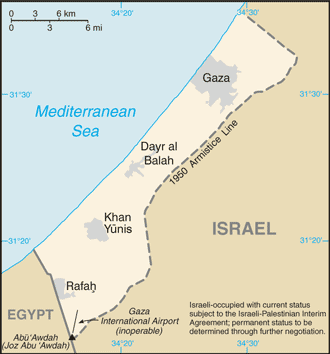
I’m writing today to express my alarm and outrage over Israel’s Operation Shield and Arrow in Gaza which the Haaretz editors have stated “raises moral and legal questions about Israel’s military”. (Haaretz Editorial May 10, 2023). I assume (hope) that you are receiving daily briefings and so I won’t recap the statistics or the devastation. More than 2 million Palestinians are enduring the trauma of deprivation, fear and potential loss of life as Israel carries out its inhumane aggression against a civilian population trapped in the densely packed Gaza Strip by Israel’s decades-long occupation and siege.
My specific requests of you are:
Make a public declaration that the U.S. recognizes and supports international humanitarian law and does not condone Israel’s preemptive military actions in the Gaza Strip and call upon the Israeli government to end Operation Shield and Arrow immediately.
Invoke the requirements of the Leahy Law which prohibits the U.S. government from funding units of foreign security forces where there is credible information implicating that unit in the commission of gross violations of human rights. As you probably know, the U.S. now provides Israel with more than $3.8 billion per year. Direct the State Department to investigate Israel’s conduct of Operation Shield and Arrow. Inform the Israeli government that U.S. funding will cease immediately until or unless the State Department’s investigation has cleared Israel of any wrong doing to your satisfaction.
Release your Administration’s report on the killing of Palestinian-American journalist Shireen Abu Akleh by Israeli troops in Jenin a year ago, and publicly acknowledge the FBI’s investigation into her killing.
Redirect the U.S. Ambassador to the United Nations who this week blocked the Security Council’s resolution condemning Israel’s current actions in the Gaza Strip. The U.S. must stand in solidarity with the community of nations who recognize and condemn Israel’s war crimes.
I’m making specific requests and would appreciate direct responses to my requests. I’m also mailing to you a copy of Light in Gaza – Writings Born of Fire (edited by Jehad Abusalim, Jennifer Bing, and Michael Merryman Lotze) published in 2022. These are stories written by Palestinians in Gaza about living under Israel’s decades long military occupation. I believe I sent you a copy of this book late last year, but I hope this copy will make it into your hands.
Don’t be numbed, don’t be lulled into complacency. As of today, Israel’s current Operation Shield and Arrow in Gaza has killed 26 Palestinians, including women and children, and injured many more. Thousands are taking shelter in their homes, although there is no protection from Israel’s bombardment.
Israeli officials say they targeted three senior Islamic Jihad commanders, a preemptive action to prevent alleged attacks on Israel. Attacking them in their homes, they surely knew their wives, children and other family members would be victims too. If the new (old) normal under international law is to condone preemptive deadly action against military leaders, then I suppose any foreign actor who feared U.S. military aggression would be justified in taking out the U.S. President and his family in a preemptive strike. Such action, whether initiated by Israel or any foreign actor, is a clear violation of international law, and the perpetrators must be held accountable.
Deliberately throwing international law into the wind is, sadly, the new normal. Take for example all of the journalists that Israel has killed.
Democracy for the Arab World (DAWN) is demanding that the Biden Administration release its report on the killing of Palestinian-American journalist Shireen Abu Akleh by Israeli troops in Jenin a year ago, and publicly acknowledge the FBI’s investigation into her killing.
Americans hear very little from our mainstream press about Israel’s military actions in support of its 75 years of occupation of Palestinians. We know nearly nothing of the context for the resistance. When the spokepersons for the White House and the State Department are put on the spot, they are adept at side-stepping reporters’ questions about Israel – Palestine. Thankfully, the questions are becoming more direct and relevant to uncovering the truth.
Don’t be numbed, don’t remain silent. Listen carefully to how the stories are presented. WAKE UP!
This might not seem the most auspicious time to reflect on a new way of thinking. Our passions and grievances (and perhaps our reptilian brain) lead us to the inevitable conclusion that we must take sides. “My side” is the right one, of course. And we put all of our energy (even during times of quiet and somber reflection during Ramadan and Passover) to proving the “other side” is wrong.
Deb Reich, author of No More Enemies, and an American-Israeli-Jew who lives on a kibbutz in southern Israel, has chosen this time to write about the need to think differently, act differently, and strike out on a transformational evolutionary path that values partnership. She writes:
Science has suggested that a long evolutionary process has molded us in certain ways because those directions helped us survive as a species. But a clear-eyed look around should be sufficient to demonstrate that some of those once-useful tweaks are now obstacles to our further evolution… beyond the zero-sum adversarial behavior that’s gotten us this far but arguably isn’t working any more. To save ourselves while being sufficiently compassionate to the planet and all its other creatures, because we’re all in the same boat, we urgently need to learn this one, crucial thing: how to function, when it counts, if not all of the time, in a win-win partnership mode that transcends our many differences and puts us all on the same problem-solving, solutions-crafting team.
Partnership (not Zion) is the Promised Land, The Times of Israel, April 3, 2023.
This might actually be the perfect moment to write because it’s easier to see the light when it’s juxtaposed with the darkness. Please read her entire blog post here, and see if you agree.
Rachel in her own words. Footage from Rachel’s interview conducted by Middle East Broadcasting Company on March 14th, 2003, two days before she was murdered by the Israeli Defense Forces. Listen. Feel. Act. Her life proves one person can make a difference!
I just received an invitation from Veterans for Peace (Chapter 63) to hear Emile Nakhleh speak on zoom on Monday evening, March 13. Born in Galilee, Palestine in 1938, Professor Nakhleh is a former CIA Senior Intelligence Service Officer, Director of the Global and National Security Policy Institute at UNM, and a member of the Council on Foreign Relations. He writes and lectures on Israeli and Palestinian issues, political Islam, Islamic radicalization, climate disaster in the Middle East, and the Arab state of the Middle East.
On the 20th anniversary of the U.S. invasion of Iraq, Professor Nakhleh published a paper entitled “The Iraq War was dominated by groupthink and absolutely no humility” in which he concluded:
Intelligence and policy expertise on Iraq were made available to policymakers at the highest levels, but such expertise and in-depth analysis were ignored. Groupthink and seemingly a lack of interest in what expert analysts had to offer underpinned the war decision, which in turn resulted in the debacle that followed.
As the country observes the 20th anniversary of the Iraq invasion and before our leaders embark on another regime change adventure, they should base their decision on deep expertise about the target country, strong and verifiable intelligence, a nationally acceptable rationale, and clear end-game objectives. Above all, they should display genuine humility regarding the limits of the United States’ ability to control the unfolding of events and the resulting outcomes and broader repercussions.
Responsible Statecraft – February 27, 2023
A year after President Biden took office, Professor Nakhleh shared his advice about how the Administration should respond to Netanyahu and the Israel-Palestine
Over the years, America’s unfettered support for Netanyahu’s anti-Palestinian policies have empowered him to jettison the peace process and continue his aggressive settlement projects in Palestinian areas of Jerusalem and the West Bank. With American support, Netanyahu has advanced the false narrative that the “Arab street” has gotten tired of the Palestinian issue, thereby giving him the excuse to ignore the core issue of the Israeli occupation and deep-seated Palestinian humiliation and misery. Arab reaction to the destruction in Gaza and the Arab uprising in Israel have unmasked the falsehood of Netanyahu’s narrative.
The Biden administration has the opportunity—and the support of a significant segment of the Democratic Party in Congress—to right this imbalance. Biden should tell Netanyahu, in word and in deed, that he sees a distinction between Israel as a state, which we support, and Netanyahu as a politician, whose policies we have the right to question. America’s support for Israel’s security doesn’t automatically extend to Netanyahu’s anti-Palestinian policies—domestically and regionally.
Netanyahu’s Obsession and the Palestinian Uprising, The Cipher Brief, May 20, 2021
This is certainly a man I want to hear from and I’m looking forward to the zoom gathering on Monday evening.
My questions for Professor Nakhleh:
Given the current realities in Israel and Palestine, and the level of official state-sanctioned violence against the Palestinians, how would Professor Nakhleh advise President Biden if he had his ear and undivided attention?
If President Biden took my advice to heart (see here) and spelled out the nature of the “special relationship” between Israel and the U.S., what would Professor Nakhleh recommend that Biden include on the list of actions, policies or norms that, if Netanyahu violated any of them, the Biden Administration would acknowledge that Israel has undermined these shared values, interests, and policy goals….and take appropriate action in response?
Who are the loudest voices on foreign policy in the Biden Administration today? What role should the American public play in trying to shape U.S. foreign policy?
What does Professor Nakhleh understand is the biggest impediment to the U.S. playing a constructive role in the Middle East?
I’m sure I’m going to learn a lot from Professor Nakhleh.
The pogroms in Germany beginning in 1938 with the Kristallnacht, the Night of Broken Glass, caught many off guard. No one had seen this level of violence perpetrated so brazenly against the Jews. Given the current pogrom against the Palestinians in the occupied West Bank, I wanted to refresh my memory of the earlier pogrom. This brief history was a good place to start.
American newspapers across the country covered the Nazi assault on Jews in front-page, banner headlines, and articles about the events continued to appear for several weeks.
At his press conference on November 15, 1938, one week after Kristallnacht, President Franklin D. Roosevelt denounced Nazi Germany’s terror attack on Jews, saying, “I myself could scarcely believe that such things could occur in a twentieth-century civilization.” FDR made an exception to his practice of off-the-record press conferences by allowing newspapers to quote this statement from his meeting with reporters that day.
The president also announced that he had recalled the US ambassador to Germany, Hugh Wilson. The United States was the only nation to recall its ambassador and would not replace him until after the end of the war in 1945.
In response to the news of Nazi terror against Jews, Americans protested in cities including New York and Los Angeles. Other Americans called for an increase in the number of immigrants allowed to enter the country.
My social media has been filled this week with images of burning buildings, destroyed vehicles and mayhem perpetrated by Israeli settlers against Palestinians in a village in the occupied West Bank called Huwara. Given how the algorithms work, I suspected that many of my friends and family were oblivious.
Major General Yehuda Fuchs, who commands the Israeli military in the area, called it a ‘pogrom’. I wondered what the Biden Administration called it, and whether the U.S. President would do anything . . . finally . . . to end our country’s complicity in Israel’s 55-year long occupation of Palestine. Or is our “special relationship” with Israel sacrosanct?
We expect the Israeli government to ensure full accountability and legal prosecution of those responsible for these attacks in addition to compensation for the loss of homes and property,” State Department spokesperson Ned Price said during a press briefing, calling the Sunday night attack by hundreds of settlers in the northern West Bank town of Huwara “completely unacceptable.”
The comments were the most forceful yet from the US following the mass riot in which a 37-year-old Palestinian man was killed, some three hundred were wounded — four seriously — and dozens of buildings and vehicles were torched.
Just to make it clear, the time for a “light touch” with Israel is over. It’s time for President Biden (not a spokesman) to denounce Israel’s attack on Palestinians perpetrated by both its military in Nablus and by its Jewish settlers in the occupied West Bank against the Village of Huwara.
Biden should recall the U.S. Ambassador to Israel, Thomas R. Nides, just as FDR did in 1938. This would send a strong signal to anyone still listening in the Knesset that the U.S. abhors Israel’s current trajectory.
Biden should articulate his view of the ‘special relationship’ so frequently mentioned, specifying the substance and policy dimensions of the two countries’ ‘shared values’. Only by clearly defining those values can the Administration make clear what would represent a departure from them by Israel, specifically as related to democracy, pluralism, respect for the rule of law, democratic institutions, and division of power, among other elements. After this list is prepared, Biden should inform the Israeli government in advance of the actions it will take if Israel undermines the ‘special relationship’. (Thanks to the proposal prepared by DAWN, February 13, 2023, available online here.)
Biden must comply with the Foreign Assistance Act (P.L. 87–195) which regulates all forms of U.S. assistance to foreign countries. It states that no assistance may be provided to a country “which engages in a consistent pattern of gross violations of internationally recognized human rights.” Israel’s apartheid laws and practices as well as its demonstrable violations of the basic human rights of Palestinians is well documented.
Biden must comply with the Arms Export Control Act (P.L. 90–629) which regulates U.S. military assistance and sales to foreign countries. It states that the United States can furnish weapons to foreign countries “solely for internal security, for legitimate self-defense,” and for a few other limited purposes. No credits, guarantees, sales, or deliveries of weapons can be given to a country if it is “in substantial violation” of these purposes. It’s well-documented that the State of Israel continues to use military force against the Palestinians in the occupied West Bank and occupied Gaza Strip in flagrant disregard for the lives and livelihood of Palestinians.
Biden must comply with the Leahy Lawswhich require the Departments of State and Defense to vet individual military units and individuals before they are eligible to receive U.S. equipment or training. The Department of State version of the law states that no form of assistance can be provided “to any unit of the security forces” committing “a gross violation of human rights.” The Department of Defense version states that no training or equipment can be given to a military unit that “has committed a gross violation of human rights.” Israel is the only country in the world for which the United States does not have tracking mechanisms to determine which weapons go to which military unit. This opacity makes it nearly impossible for the Departments of State and Defense to properly implement Leahy Law vetting requirements. WAKE UP! The State of Israel’s actions in the occupied West Bank and occupied Gaza Strip fit both definitions. (Thanks to Josh Ruebner, Salih Booker and Zaha Hassan for their informative article published by the Carnegie Endowment for International Peace, entitled Bringing Assistance to Israel in Line with Rights and U.S. Laws (May 12, 2021) (available online here).
Mr. President, the settlers’ attack on the Palestinians in Huwara is much more than “completely unacceptable”, it’s a pogrom carried out with U.S. complicity if you don’t speak up now and take explicit actions required by U.S. law.
Thank you to Michael Lynk for highlighting the U.S. role in shielding Israel from censure or criticism at the United Nations in his recent piece in DAWN.
Americans should pay attention. Lynk is the former United Nations Special Rapporteur for human rights in the occupied Palestinian territory, from 2016 to 2022. He taught in the Faculty of Law at Western University in Ontario from 1999 to 2022. He is, most recently, the co-author of “Protecting Human Rights in Occupied Palestine: Working Through the United Nations,” with Richard Falk and John Dugard.
The U.S. hypocrisy is laid bare with just a few facts in Lynk’s article.
Since 1973, the United States has cast 81 vetoes at the U.N. Security Council, far more than any other permanent member; Russia and the former Soviet Union is in second place with 38 vetoes during that time period. More than half of these American vetoes, 42, have been used to skuttle resolutions critical of Israel: 32 vetoes dealt with the Israeli occupation of Palestine, while the other 10 defeated resolutions critical of Israel’s invasions and occupation of Lebanon. In each case, the U.S. was the only permanent member of the Security Council casting a veto. No other permanent member of the Security Council has ever vetoed a resolution critical of Israel or the Israeli occupation of Palestine over the past 50 years. In his 2020 memoir, Barack Obama lamented the discomforting position that the U.S. regularly found itself in during his presidency when defending Israel at the United Nations and other international forums:
“… just about every country in the world considered Israel’s continued occupation of the Palestinian territories to be a violation of international law. As a result, our diplomats found themselves in the awkward position of having to defend Israel for actions that we ourselves opposed.”
To be sure, the U.S. has still regularly enabled the Security Council to adopt resolutions critical of Israel—77 in total since 1967. These resolutions have condemned the Israeli annexation of East Jerusalem and the Syrian Golan Heights; emphasized the legal principle that the acquisition of territory by force or war is inadmissible; and stated that the Fourth Geneva Convention of 1949, which protects the civilian population in occupied territory, applies in full to the West Bank, including East Jerusalem and Gaza. In 1980, the Security Council, with the Carter administration abstaining, adopted Resolution 476, which “reaffirms the overriding necessity for ending the prolonged occupation of Arab territories occupied by Israel since 1967” and “strongly deplores the continued refusal of Israel, the occupying power, to comply with relevant resolutions of the Security Council and the General Assembly.” One might ask, if the Security Council and even the U.S. deemed the Israeli occupation to have already been “prolonged” and requiring a swift conclusion by 1980, after only 13 years, how should it be labeled in 2023, after almost 56 years?
Americans of conscience must use these facts that Professor Lynk has laid bare and press our members of Congress and the Biden Administration to end our country’s indefensible position at the U.N. Security Council. Even those skeptics who don’t care a twit about Palestine should be concerned about the future viability of the institution of the United Nations when one member (the U.S.) can so tragically muck up the wheels of justice.
Israel’s military entered Nablus in occupied Palestine to “preemptively” “neutralize” three “suspects” who were allegedly “planning attacks in the immediate future.” The timing was exquisite, coming on the heals of Secretary of State Blinken’s diplomatic visit.
The Israeli military’s daytime raid began at around 10:15 a.m. (3:15 a.m. ET), Ahmad Jibril, the local director of Red Crescent, told CNN. It is “a time when everyone is out shopping in the open market of the old city. No one expects an invasion at this time of the day,” he said.
There were Israeli snipers on the rooftops shooting live ammunition, he said. “That’s why many people were shot in the head, shoulders and backs,” he said. Most of the dead were shot in the head, he added.
“People who were unarmed and even away from the old city were also shot. Bullets were everywhere!” he said.
Even by Israel’s standards, this was a brazen affront against international law and a big “FUCK YOU” to the Biden Administration.
The IDF killed 11 Palestinians and wounded 102 before withdrawing from Nablus.
U.S. Secretary of State Tony Blinken and Israeli Prime Minister Benjamin Netanyahu in Jerusalem on Jan. 30. Photo: Ronaldo Schemidt/AFP via Getty Images
Summary of call: Secretary of State Antony J. Blinken spoke today (Feb. 18) with Israeli Prime Minister Benjamin Netanyahu to reiterate our support for a negotiated two-state solution and opposition to policies that endanger its viability. The Secretary underscored the urgent need for Israelis and Palestinians to take steps that restore calm and our strong opposition to unilateral measures that would further escalate tensions. The Secretary and Prime Minister also discussed broader regional challenges, including the threats posed by Iran, and the Secretary underscored our ironclad commitment to Israel’s security.
My message to President Biden: Netanyahu doesn’t give a flying FU*K about your diplomacy, about a two-state solution, or any damn “shared values” between the U.S. and Israel. You’d better tell the American public what you consider our ‘special relationship’ to be, specifying the substance and policy dimensions of the two countries’ so-called ‘shared values’. Only by clearly defining those values can you set the U.S. apart from Israel’s flagrant violations of human rights and international law, such as the slaughter in Nablus this week. And you should make clear what would represent a departure from those ‘shared values’. Otherwise, you and your Administration are joined at the hip with a country that “preemptively” assassinates Palestinians with impunity. (Israel has murdered 62 Palestinians so far in 2023.)




 لماذا غزة؟ Why Gaza?